
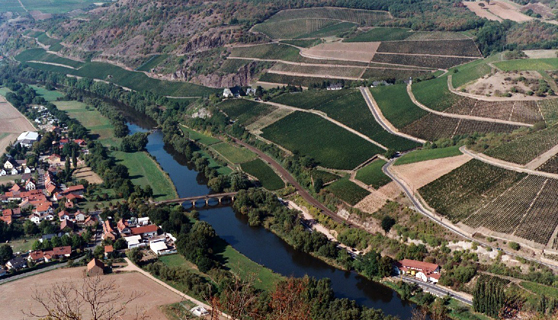

Hessische Bergstraße
I have a great love for the little region of Hessische Bergstraße. It lies on the eastern side of the Rhein River across from the Wonnegau of southern Rheinhessen. The HB competes mightily with Sachsen for the title of the smallest German Weinbaugebiet at 440 ha, and is one of only two wine-regions in the state of Hessen (along with the Rheingau.) It is a weekend paradise of hiking and bike trails and the views from the vineyards are some of the most beautiful in Germany with the rolling, tree covered hills topped with castles high above the historic timber-framed towns below.
Because of its size, it isn’t often a major-stop for Foreign tourists with a thirst for German wine, which is a shame. The demand for these wines from the local population and from the nearby cities of Darmstadt, Frankfurt, Mannheim and Heidelberg means that there isn’t much left for export anyway, and the small plots owned by many different feierabend winegrowers means that much of the grapes are processed through cooperatives. Still, there are exemplary producers to be found and at their best, these wines can play ball with those from other regions in Germany and the unique expressions of Riesling, Grauburgunder (Pinot Gris), Weißburgunder (Pinot Blanc) and Spätburgunder (Pinot Noir) are worth the effort to visit. The vineyards largely face south and west, giving them direct exposure to the sun at its hottest in the afternoon. Because of this, the wines are generally riper and more powerful, though because the best vineyards are at a reasonable altitude, some acidity is retained.
The soils are varied, with Granite, Sandstones, Porphyry, Limestone, Loess and Loam. The three top vineyard sites are represented below, though there are a dozen or so very fine vineyards in this small region (other examples are the Schönberger Herrnwingert for GG Weißburgunder and Zwingenberger Steingeröll for Riesling from Simon-Bürkle.)
2010 Domaine Bergstraße (Kloster Eberbach) Bensheimer Kalkgasse Riesling Kabinett Trocken –Hessische Bergstraße, Germany 12,5% alc.Flat out wow! This is a super Kabinett and just dry. Mineral, mineral, mineral- Long, taut, and completely devoid of aromatic pleasantry and spice accents, it is the business end of Kabinett. Pure and no nonsense. Peach, pear and chalky mineral with loads of reverb. Damn good. The Kalkgasse is a mix of Granite and limestone.
2010 Domaine Bergstraße (Kloster Eberbach) Heppenheimer Steinkopf Riesling Spätlese Trocken –Hessische Bergstraße, Germany 11,5% alc.Very juicy key lime and white peach fruit, almost minty with cool, clean mineral notes. A lighter-styled Spätlese with enough acidity and just the slightest hint of RS. Very good. –Sandstone soil with some iron.
2010 Domaine Bergstraße (Kloster Eberbach) ‘Crescentia’ Heppenheimer Centgericht Riesling Spätlese Trocken –Hessische Bergstraße, Germany 12,5% alc.Powerful and densely packed. Caramel apple, hazelnut, cinnamon, an almost gritty texture, and with a smoky minerality –that not too common for the Centgericht. Acidity is lacking and it almost goes Pinot Gris on a mofo. I’m left thinking that they may have let it go through BSA, but it’s good, especially with the Alsatian bacon and onion Tarte Flambee that we rocked tonight. Sand, Loess, Loam.
Cheers,
Bill