

A Pfalz Primer:
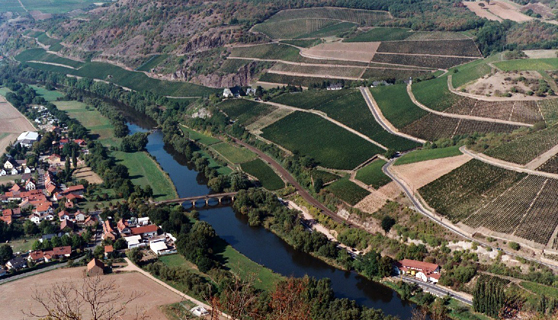
The Pfalz lies just to the north of Alsace and can actually be considered a northern continuation of that region across the line into Germany. The Vosges Mountains check their name at the border and become the Haardt Mountains covered with dense forest all the way to the Saarland and Luxembourg to the west. The shelter that these mountains provide make the Pfalz is the driest and sunniest area in Germany (as is Alsace in France). Along with the vineyards, almond trees, plums, cherries, apples and pears, figs and even lemons dot the landscape. To the east lies the Rhein, though the vineyards begin some twenty kilometers to the west and aren’t influenced by the moderating effects of the river as much as those sites found directly adjacent to it as can be found further north around Nierstein and Bingen in the Rheinhessen, and most of the entire Rheingau and Mittelrhein Weinbaugebiete. Despite this, the wines bear an unmistakable resemblance to the family of Rhein Riesling as the apple, pear, pommace fruit flavors of the Mosel give way to riper, tangier, peach, apricot, stone-fruit and perhaps more exotic spice character of the Rhein. The soil types are extremely varied, as much as any region in Germany, and because of this, along with the mild climate, the cultivation of many different varieties is possible. There are some EIGHTY different varieties planted in the Pfalz (if you like, I can name them), some legally recognized, some not.
Riesling is the number one grape vine planted in the Pfalz occupying almost a quarter of the area, the second most planted in Germany after the Mosel. And though there are also large plantings of wines more suitable to simple quaffers (Müller-Thurgau, Dornfelder, and Portugieser), The Pfalz also produces world-class Pinot Noir (Spätburgunder), Pinot Gris (Grauburgunder), the best Gewürztraminer in Germany, and arguably the best Pinot Blanc (Weißburgunder), Scheurebe and Dry Muscat in the world. The Pfalz is also home to the most St. Laurent in Germany and is catching up to Austrian versions in quality. Silvaner is on the upswing (as it is again in many German wine regions) as better sites are being used. International varieties are also very much en vogue and good Sauvignon Blanc, Chardonnay, Syrah and even Cabernet Sauvignon, Franc and Merlot can be found. The three grapes approved for Großes Gewächs are Riesling, Spätburgunder, and Weißburgunder.
There is a lot of Sandstone with varying amounts of iron and other minerals. Sand generally gives ripe wines of much concentration but small yields because the water and nutrient-holding ability of these porous soils is minimal. The Riesling grown on sand can have a very exotic aromatic component and it is for this reason that Gewürztraminer and Gelber Muskateller (Muscat Blanc de Petit Grains) are also well suited for Sandstone. Rotliegend is a strata of red sandstone sometimes speckled with other rock formations. There are many, many vineyards of Sandstone in the Pfalz, most of them on the slopes adjacent to the forest. Müller-Catoirs Bürgergarten Breumel in den Mauern (a beautiful Clos vineyard in Haardt), Gimmeldingen Mandelgarten and Biengarten, Ungsteiner Herrenberg, Ruppertsberger Gaisböhl and part of the Siebeldingen Im Sonnenschein are but a couple.
Mergel (Marl) and Kalkmergel make up pieces of some of the best Spätburgunder (Pinot Noir) and Riesling vineyards in the Pfalz. The Königsbacher Idig, parts of the Birkweiler Kastanienbusch, the Gerümpel in Wachenheim, and the Bad Dürkheim Michelsberg are examples.
Kalkstein (Limestone) can also be found from north to south and is the preferred soil for Pinot Noir as the wines show excellent minerality and elegance but also for Riesling. The Schweigener Kammerberg and Sonnenberg vineyards are comprised of weathered limestone where Becker and Bernhart make their best wines. Deidesheim also has a high proportion of various limestones as does Laumersheim where Knipser and Kuhn reside. One of the most famous vineyards in Germany, the Kallstadter Saumagen was originally a Roman limestone quarry. Koehler-Ruprecht makes some of the longest-lived Rieslinge in Germany from this site.
Muschelkalk (Limestone soils with high proportions of shell) is important for Spätburgunder (Pinot Noir), Weißburgunder (Pinot Blanc), Auxerrois, Riesling, and Silvaner. Important vineyards of Muschelkalk are the Birkweiler Mandelberg, Siebeldingen Im Sonnenshein, Leinsweiler Sonnenberg and Ilbesheimer Kalmit.
Keuper is dolomite, claystone, shale that lies on top of stratas of Muschelkalk. It appears in Wachenheim and is ideal for Silvaner.
Basalt can be found in the mix with sandstone, chalk, clay and loess in the vineyards of Forst (Jesuitengarten, Kirchenstück, Ungeheuer), a village whose vineyard holdings are regarded by many as the best in the Pfalz. If you had to explain to someone what the Mittelhaardt and the Pfalz is all about in one wine, a Forster would be the litmus test and the archetype of the region (Just as a Wehlener Sonnenuhr might be the logical choice from the Mittelmosel.)
Slate (Schiefer in German) can only be found in a few vineyards, notably the Burrweiler Schäwer (local dialect for Schiefer) and neighboring Weyher Michelsberg. Excellent Rieslinge are made from these vineyards at the hands of Weingut Meßmer. Mosel mineral, Pfalz exotica.
Clay can also be found mixed throughout the Pfalz. It has very high water and nutrient retention, but can also delay ripeness in wetter, cooler years. It is hell to work in dry conditions.
Loess is very fine windblown sediment normally mixed with sand and clay. As one retreats from the mountains towards the river Loess becomes very prevalent, but it is also found mixed into many of the better vineyards throughout the Pfalz. The Kirrweiler Mandelberg is a prime example (Bergdolt makes excellent Weißburgunder here) as is the Laumersheimer Kirschgarten for Spätburgunder, Weißburgunder and Riesling.
Loam can also be found mixed into some very good vineyards (Ungsteiner Weilberg for instance), but those with very high proportions of Loam are found further into the Rhine plain and produce fruity if uninteresting wines and high yields. Many of these vineyards lie in frost pockets and have been more recently planted to vines whereas earlier more mixed agriculture of fruit and vegetables occupied this land.
The Pfalz is Germanys second largest wine region (23.000+ ha, almost a quarter of German vineyard area) and though I have read it described as daunting and immense, it is actually quite easy to understand. The whole of the region lies on an 80 km north-south axis (like Burgundy or Alsace) roughly following the slope of the mountains to the west and the river to the east. The region can be split up into three subregions (and much like the Mosel, where these lines are drawn is open to interpretation):
The Unterhaardt or northern Mittelhaardt starts at the Rheinhessische border with the village of Bockenheim and continues south to Bad Dürkheim. This is the driest and most sheltered area of the Pfalz and as such, red wine plays a very important role here. Cabernet Sauvignon, Merlot, Cabernet Franc, Sankt Laurent, even Syrah are planted. (Important villages are Dirmstein, Laumersheim, Großkarlbach, Freinsheim, Kallstadt, and Ungstein.)
Producers to know are: Knipser, Philipp Kuhn, Koehler-Ruprecht, Pfeffingen and Zelt.
The Mittelhaardt (Bad Dürkheim south to Neustadt) is the most historically significant area with the lionshare of the large historical producers as well as the biggest proportion of great vineyards. Bad Dürkheim, Wachenheim, Forst, Deidesheim, Ruppertsberg, Königsbach, Gimmeldingen, Mußbach and Haardt make up the Mittelhaardt (sometimes called the Mittelhaardt Süd.) Practically all oft he vineyards are located on the slope very close to the forest (which provides great protection from the elements, one of the only drawbacks being all of the wild boars which feast on the bunches (though there is absolutely worse eating than spit-roasted, Riesling-fed wild boar.) The grapes tend to ripen a week or ten days ahead of those in the Südliche Weinstraße. The only criticism that could be hurled at some of these producers is the same which one hears about some of the Rheingauers: that of laurel-resting. Despite that, the quality is very high even among the biggest estates (the 3Bs of Bürklin-Wolf, Bassermann-Jordan and von Buhl.) These estates are not only fixtures of ongoing quality, but have also done their share of pushing the envelope in the form of vineyard classification and biodynamic viticulture.
Producers to know: Bürklin-Wolf, Bassermann-Jordan, von Buhl, A. Christmann, Georg Mosbacher, Müller-Catoir, Acham-Magin, Deinhard/Von Winning, Eugen Müller, Fitz-Ritter, Schäfer, Johannitergut, Biffar, Weegmüller, Odinstal and Darting.
The Südliche Weinstraße (every Village south of Neustadt to Wissembourg in France –The most southern Pfälzer vineyards actually and legally lie across the French border, an interesting arrangement that pre-dates the wars of the last century) is the region that has proven to be the most exciting over the last decade (and beyond) with very rapid advances in quality. Many of the estates here haven’t had the historical constraints of the Mittelhaardt and as a result have been a little more free to experiment. Until producers like Rebholz emerged in the 1970s, the Südliche Weinstraße was best-known for bulk wine and the enourmous yields that the south Pfalz sun was capable of giving. Today the quality matches and in some cases surpasses that of the rest of the Pfalz. Riesling is important, but Burgundy varieties have also gained a foothold. Major Villages are: Hambach, Deidesfeld, Duttweiler, Maikammer, Kirrweiler, St. Martin, Edenkoben, Edesheim, Rhodt, Burrweiler, Flemlingen, Gleisweiler, Siebeldingen, Godramstein, Ilbesheim, Birkweiler, Leinsweiler, Schweigen.)
Producers to know: Wehrheim, Rebholz, Meßmer, Theo Minges, Friedrich Becker, Bernhart, Jülg, Bergdolt, Kranz, Jürgen Leiner, Siegrist, Münzberg, Ziegler, Kranz, Moll, Villa Pistoria.
The Prädikats in the Pfalz are often used in conjunction with an internal rating system by a particular estate. To take Müller-Catoir for example:
‘Klassiker’ –Village-level Kabinett: Haardter Riesling Kabinett Trocken
‚Terroir‘ Single-Vineyard Spätlese (and GG): Haardter Herrenletten Riesling Spätlese Trocken; Haardter Bürgergarten ‚Breumel in den Mauern‘ Riesling Großes Gewächs
‘Kult’ –Single Vineyard Nobel-sweet wines: Haardter Herzog Rieslaner Beerenauslese
The VDP classification (like in some other regions) is based on Estate and Village wines, Single-vineyard wines, and GG and Auslese and up sweet wines.
There are producers such as Koehler-Ruprecht who use the old Prädikat system almost exclusively, and others who have abandoned it altogether in favor of internal classification like Bürklin-Wolf who uses Estate, Village, PC (Premier Cru) and GC (Grand Cru).
The vast majority of the wines produced in the Pfalz are dry. The styles range from very traditional (again Koehler-Ruprecht who uses old oak and sponti without temperature control) to shimmeringly modern (Kurt Darting is a good example. Reductive, mostly stainless-steel, cooler fermentations) and all combinations thereof.
To my mind, the very finest producers are (in no particular order):
Christmann, Müller-Catoir, Knipser, Kuhn, Koehler-Ruprecht, Rebholz, Bergdolt, and Becker, though all of the producers that I listed above are top-notch.
Cheers,
Bill