
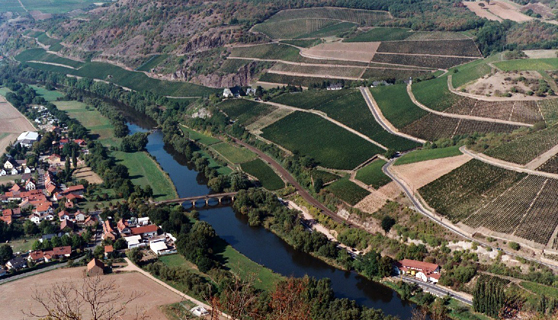

We went wine tasting in the Finger Lakes region of New York last week. We didn't end up visiting that many wineries, as our fascination with the Corning Glass Museum and the Gorge at Watkins Glen basically killed one of the two days we'd allotted to this activity. Which was too bad, because it really took most of the first day to get our palates calibrated to the highly acidic local style, even for someone like me who favors that. But overall it was an enlightening experience that showed the potential for riesling and gewurztraminer in this area and the struggle to nail down the tannins needed to make red wines like pinot noir and cabernet or other vinifera like chardonnay interesting.
I took detailed notes but find, looking back, that it would be tedious for anyone else to read them were I to type them all up here. Better that I give an overview of the experience at each, though I might refer occasionally to the letter grade I give each in these circumstances.
Heron Hill
Overall, the wines were competent and well-made. We tasted chardonnay, pinot blanc, several rieslings and pinot noirs, cab franc and blaufrankisch. The reisling(s) and reserve blaufrankisch showed best, where the pinots and cabernet franc were a bit wan and in need of more varietal character.
Dr. Konstantin Frank
Although historically speaking this is one of THE wineries to visit while here, after our visit I can truthfully aver that I would never EVER send a serious wine person to this winery. Outside the building, one is herded into groups and then sent to the next available bar, like cows to a milking machine, for a very robotic and impersonal tasting designed to move you to the cash register as fast as possible. They pour a selection from their rather long list of products and you do not get to choose the wines you taste. That treatment cast a pall over the wines we couldn't shake, but in spite of that I did like the brut sparkling wine well enough to buy a few bottles for in-room entertainment later, plus the dry gewurztraminer which I thought the best of all the wines poured. A day or so later I chilled and opened that brut sparkler ($25) with our friends, and I couldn't believe I'd liked it. It was more Extra Dry than Brut, and just lacked any sign of the three true champagne grapes it was made from. I hope I'm not similarly disappointed with the gewurz (which I brought home). All the reds poured were below average. (P.S.: Dr. Frank has died and his grandsons are now running the joint--it shows.)
Ravines Cellars
This winery validated our disappointment with the previous two wineries because the wines were markedly better, although they did also provide a Tasting-Room-Mistake-Hall-of-Fame moment we'll never forget. We liked the 09 Dry Riesling, loved the 08 chardonnay (in which 30% of the grapes are dried, amarone-style, to beef up the body), found the two hybrid 'Keuka Village' wines delightful little puppy wines, and quite enjoyed the 09 Cerise (PN and Lemberger), 08 Cab Franc, 07 Meritage and the 07 Merlot. My notes on the 08 Pinot read "Finally! Real Pinot!". Basically, we liked everything but two wines, a skunky Sauv Blanc and a pinot noir rose (saignee) that provided the previously referred-to Moment: while pouring this, our server warned us not to pick up our glasses until he gave permission. Once all the glasses had something in them, he instructed us to clip two fingers over our noses, like clothespins, and then sip in unison without smelling. He then blamed the putridity on the glassware. I KID YOU NOT. Bottles of the chardonnay and pinot were purchased and consumed elsewhere along the trip, and lived up to our memory of them in the tasting room.
Anthony Road
Our pourer at Ravines sent us here to tast something in particular, but which was sold out. So we tasted a dry riesling and a chardonnay, both of which had the simplistic lemon-lime flavors of Yellow Tail whites, and left.
Red Tail Ridge Winery
Where some wineries use the word 'lemberger' and others call it 'blaufrankisch', this winery strangely had one of each. When we asked if the fact that the 08 was the former and the 09 the latter indicated a move toward standardization, our server told us "I don't know!" That was the answer to several other questions we asked, too, about how the wines were made. So we didn't learn much, but I found too much RS and malo in the chardonnay, some wierd vinyl aromas on the lemberger, and the remaining wines just average. Interestingly, though, this winery does make a Teroldego, a grape we didn't encounter anywhere else. They also made a sparkling red with it that we didn't get an opportunity to taste.
Damiani
Here's the winery that set the highest standard for us. Most of the wines got a B grade from me, only a NV cab blend and their 09 Merlot falling shorter. Important fact: they use only French Oak and no new oak. A Chardonnay was okay but no contest for the Ravines' version. The Reislings and Gewurz were very good and the pale orangey-red pinot had the most pinot character of the trip. Verging on the only A grades I gave the whole trip were the 2010 Sauvignon Blanc, the 09 Cabernet Franc and the 08 Cabernet Sauvignon Barrel Select.
Other wines we drank while there: we couldn't visit Shalestone though everyone reccomended them highly, so ordered both their top blends over dinner one night at Dano's Heuriger, our fave restaurant of those we tried. Shalestone brings up at least some of their fruit from Long Island's more temperature zone, hence the Syrah in the Synergie, which with cabernet and merlot results in beet, cherry and tomato flavors. Sensuous mouthfeel, but no tannins. We also enjoyed (and in a vote, favored) the more-Bordeaux styled blend, Harmonie, a mix of Cab, Cab Franc and Merlot that showed some dill (american oak?), dust, black currant and spice.
A King's Garden non-vintage cabernet sauvignon was overripe and oxidized, an 07 Lamoreaux Landing Cabernet Franc was too dilute and green (especially for one of the better recent vintages), and a Glenora sparkling brut had soda pop sized bubbles and Andre flavors--seriously BAD.
I might throw in a mention that in Vermont we tasted the local product too. A 2010 East Shore Vineyard Marquette was the best of the lot, but not so much because it was so good but because the Snow Farm Vineyard Leon Millot and Boyden Valley Big Barn Red we also bought were so strange.

 Very strange wine, even to my palate