
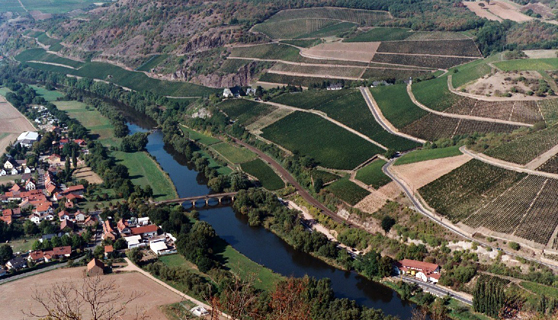

Considering that the wine focus of the month is Alsace, I thought it might be of interest to some to read this piece I wrote about a decade ago. I have been in Alsace several times in the intervening years and to the best of my knowledge, the information remains current.
Four Days in Alsace
© Daniel Rogov
There are three kinds of fish that swim in the canals of Stras-
bourg - catfish, carp and gudgeon, and there may be no way no more
pleasant way to pass a winter afternoon than by bundling up in
three or four layers of warm cothing and sitting on the banks of
one of the canals with a long fishing pole in hand and reflecting
on fish, the sky and the fact that most people consider Stras-
bourg as a rather dull city. All of which is fine, for the fish
are delicious; even on the worst winter day the sky always can be
counted on to turn a sparkling blue for at least two hours; and
the lack of large numbers of winter-time tourists simply adds to
the many charms to be found in this charming city.
My day had started a few minutes before seven in the morning when
the clerk at my hotel phoned to ask me what I would like for my
breakfast. Strasbourg is the only city in the world and the Termi-
nus Gruber is the only hotel at which I would dream of ordering
pate de foie gras for breakfast, but goose liver in every form is
so closely associated with this Alsatian city that it has become
an inescapable but delicious part of daily life. The hot pate that
made its way to my room, with the distinct taste of cognac and
juniper berries was lovely, an excellent example of the most ac-
claimed specialty of the region, and as light and delicate as one
could have wanted. The fact that it was served with an abundance
of fried onions and came with fresh rolls that had been lightly
seasoned with cumin added to the charm of the meal.
The fact that they make the unquestionably finest pate de foie
gras in he world is only one of the things that gives Alsace its
unique charm. Situated between the Vosges Mountains and the Rhine
River, the region has been invaded and fought over since Roman
times. Despite their Germanic dialect, however, the people here
are uniquely French and unlike their German neighbors maintain a
sense of lightness in nearly everything they do. Warmer and more
welcoming than most other Frenchmen, Alsatians in Strasbourg, Col-
mar or any of the outlying villages take nearly every event as a
cause for a celebration. The corn and grape harvest, minor re-
ligious holidays, the onset of the birthing season for cows and
the first wines of the year are all reasons for local fairs,
feasts and a general air of celebration.
There are two distinct divisions to the city of Strasbourg - the
new city, built primarily in the 18th century and the old, where
most of the buildings date to the 15th and 16th centuries. It was
in the old quarter, known as La Petite France, that I was strol-
ling by ten in the morning, marveling, as I always do, how these
wood beamed buildings manage to remain standing. Some do so by
leaning against their neighbors. Others, even though they lean at
remarkable angles, seem supported only by the hopes and prayers of
their occupants. One local folk-tale has it that the old quarter
is under the protection of Sainte Anne and that it is due to her
love for the city that not a single building has collapsed since
1798.
It was a cold morning, and before too long I made my way into
Strissel, one of the local cafe-restaurants that from noon until
late at night serves regional specialties but in the mornings is
open primarily to serve those who want coffee or other warming be-
verages. Like others of these popular establishments where mixed
crowds of rich and not so rich, old and young mix freely and where
the prices are generally quite reasonable, the rooms here are
panelled in age-darkened wood. Despite its apparent age, Stris-
sel's is considered something of a youngster, having been in the
same family for only 160 years.
Gretl Shrodi, the great-grandaughter of the founder and a long-
time acquaintance, greeted me warmly but rejected my request for
coffee, insisting instead that I sample some of her fruit
brandies. The brandies, or more accurately eaux-de-vie, of Alsace
are justifiably famous for their smoothness and delicacy. Even
though they are best taken as digestifs after a meal, one cannot
deny that they make marvelous sipping at any time during a cold
day, and before I could make too much of a protest, four small
glasses had been placed in front of me and all present were
waiting for my comments. I was perfectly willing to go along with
Gretl's playfulness but in the name of sobriety insisted that I be
given a small cup of strong espresso coffee between each tasting.
The framboise, perhaps the most famous brandy of Alsace, is made
from raspberries and was superb; the fraise made with strawberries
was a delight; the mirabelle, of plums, was marvelously smooth;
and the kirsch, made from cherries was as potent but as pleasant
as any liqueur that I have ever sampled.
The coffee had helped but the brandies had put me in an odd mood,
a pleasant combination of reflection and raging hunger for the
special cuisine of the region. Alsatians share a fondness with the
neighboring Germans for sauerkraut, pork, goose, sausages and
other foods that are especially hearty. Unlike the Germans or
other French cooking styles, however, Alsatians use pork or goose
fat as their primarily cooking oil. Red and white cabbage are the
most popular regional vegetable, potatoes are served with nearly
every meal and asparagus are considered a necessity of life when
they are in season. Carp, trout and pike are the most popular
fish, the sausages and hams made here are superb and the foie gras
is legion.
Even though there are restaurants that draw on classic and nou-
velle cuisines, the most popular dishes are those that have evol-
ved locally. Choucroute garni, a Gargantuan feast of cooked sauer-
kraut, pork, goose and potatoes is almost always appreciated as
are dishes of poultry and fish that have been cooked in Riesling
wine. Roast goose stuffed with bread, carrots and raisins is ex-
tremely popular, especially during the winter months and, because
Strasbourg has always had a large Jewish community, the dish known
as carpe a la juive - Jewish style carp that has been cooked in
dry white wine and served with raisins, is also considered a
staple of the area.
Alsatians also take pleasure in dining on a wide variety of con-
fectionaries and cakes. The local macaroons, pastries and choco-
lates are excellent, and the best known cake of the region is
Gugelhopf, a circular cake with sculpted sides and a hole in the
center that is dusted with confectioners' sugar. No less admirable
are a number of original and delicious regional breads made from
different types of flour and flavored with cumin, cinnamon and
nutmeg.
The brandy and my thoughts on food had triggered a raging appe-
tite and I made my way by foot to the Maison des Tanneurs, one of
the prettiest and most traditional Alsatian establishments. Dating
from 1572 and in the heart of the Petite France district, the
quiet rustic dining, paneled in dark wood from top to bottom has
never failed to please me. Nor have I ever been disappointed by
the traditional cuisine served here. The fillets of Dover sole
with which I started my lunch had been flown in fresh that morning
from the English Channel. Poached in Riesling wine and seasoned
with caraway and oregano, the dish proved a delight as did the
roast guinea fowl that was served with a melange of green peppers
and leeks. A carafe of local Pinot Blanc wine went marvelously
with the meal.
An hour of fishing after lunch produced six gudgeon. These fish,
once the joy of such diverse characters as Ernest Hemingway,
Charles de Gaulle and Inspector Maigret, long ago disappeared from
the waters of the Seine are now found only on occasion in the
canals of Strasbourg. On my return to my hotel, I presented the
fish to Jean-Paul, the doorman, who in turn promised me the
everlasting devotion of his entire family.
After a few hours of rest, I met friends for dinner at Le
Crocodile. Considering all that I had already consumed this day, a
heavy meal was not what I needed, so I restricted myself to a
relatively light repast based on two appetizers. Everything that
Emile Jung prepares in his kitchen here has a remarkable delicacy,
and the river perch in a juniper flavored cream sauce and the
poached salmon with leeks were both superb. The local Riesling
that I drank was typical of those of Alsace. Dryer than most
German Rieslings, with a clean taste and a fresh, flowery bouquet,
the wine was a perfect accompaniment to the meal.
The Terminus-Gruber, located directly opposite the railroad
station, may not be the most fashionable or most expensive hotel
in Strasbourg, but it has long been my favorite. The warm greet-
ing that awaits regulars or newcomers, the halls that are deco-
rated with 16th century country-style furnishings and the spa-
cious, well designed rooms and suites, all with king-size beds and
baths are much to my liking. I also have a great fondness for the
hotel's restaurant, the meticulously decorated Cour de Rosemont,
where one can dine on classical cuisine in front of a large fire-
place. I especially enjoy the fact that even if one sleeps until
noon, as I did the next day, that fresh hot croissants will be
available for breakfast. That the croissants were served with
the raspberry and currant jams for which the region is noted added
to my pleasure as did the kindness that impelled the kitchen staff
to add a half-bottle of good Riesling wine to my breakfast tray.
Thus fortified, I decided to stroll in the new town, there to
do some window shopping in some of Europe's most luxurious leather
and kitchenware shops, places where both the prices and the quali-
ty are phenomenal. From here I made my way to a rehearsal of the
choir at the city's glorious cathedral. Whether I was more deeply
moved by Handel's oratorio, "Judas Maccabaeus" or by the superb
carvings and exquisite stained glass of the cathedral is difficult
to say.
Because I had agreed to go meet a fried for dinner later that
evening, I decided to have only the lightest of lunches, and even
though it is difficult to resist some of the more daring dishes
offered by Antoine Westermann at his restaurant, Buerehiesel,
settled on a salad of lobster with dill, and frog's legs with
chervil, both of which bordered on perfection and were made even
more pleasant by the ambiance of the old and elegant dining room
in which we had been seated. Even though my meal had been a light
one, as I left this ravishing establishment, situated in the Parc
de l'Orangerie, I remained firm in my belief that this continues
to be one of the finest restaurants in all of France.
The town of Illhaeursen is situated sixty kilometers south of
Strasbourg. Like many of the small villages along the Alsatian
route de vin, the town boasts steep cobbled streets and wood-
beamed houses with red tile roofs. The fields of tobacco, corn
sugar beets, barley and potatoes blend quietly into the tree-
lined hills and, on many of the hilltops one sees the ruins of
14th and 15th century castles. Although any of these would be
enough to draw me here, the ultimate reason for coming to Ill-
hausren is to visit the restaurant known as the Auberge de l'Ill,
where the Haeberlin family holds court at one of the finest
restaurants in the world.
This is an establishment where the welcome and the service are
always flawless and the lovely garden and willow trees at the edge
of the Ill River add to the charm of the large but comfortable
dining room. It is also a place where the professionalism of chef
Paul Haeberlin and his son Marc never fail to astonish.
As appetizers we sampled crayfish with beans that had been sea-
soned with coriander, the brioche of foie gras with truffles, the
salmon souffle and a warm salad of green lentils with goose liver,
all of which were admirable in every way. After hors d'oeuvres
like this one almost anticipates a let-down but this was not to be
our experience. Our main courses, supremes of chicken in old
sherry wine accompanied by a gratin ravioli with morels and
foie gras; a mousseline of frog's legs; a feuillete of squab with
cabbage; and a young wild partridge garnished with green wheat
were each excellent examples of the kinds of dishes one should
expect in a great French establishment. Although we decided to
stay with local Riesling wine through our meal, we were happily
seduced into trying a remarkable late harvest Tokay from Hugel
with our dessert, a magnificent bavaroise with blackberries.
On awakening the next morning, it took neither a great deal of
intelligence nor more than a modicum of insight to realize that
this was to be a day of extremely light dining. A single croi-
sant and two cups of coffee proved adequate for breakfast, and a
Strasbourg sausage, purchased at a bake-shop in the old city and
eaten as I strolled along the edge of the canal made for a fine
lunch. For dinner, taken at the unpretentious L'Ami Shutz, I
settled on a single course of kidneys in vinegar, another popular
Alsatian specialty that is offered here daily to the great joy of
locals and visitors alike. Taken with half a pitcher of Sylvaner
wine, the meal was pleasant enough to be memorable and light
enough to allow my liver and stomach a well earned rest.
The next day was a Sunday, the ideal day for driving along the
small roads that weave through the vineyards of Alsace. The route
is a pleasant one, and one weaves their way past ruined castles
while making their way through romantic towns that retain much of
their medieval charm. Alsatians treasure their wines and their
vineyards are spread along the entire length of the eternally
green Vosages Mountains and along the hills lining the Rhine.
There are two major differences between the wines of Alsace and
those found in most other parts of France. First, because many of
the vines planted here originated in Germany, Alsatian wines are
more German in character than French. Even the bottles, with
long, sloping sides are similar to German bottles. The fact is,
however, that the soil of Alsace is radically different than that
found only a few kilometers away in Germany, and these wines have
a character uniquely their own. The second difference is that un-
like most French wines that carry the name of a specific region or
town, Alsatian wines are usually varietals that take their names
from the grapes from which they are made.
Wines produced from the Riesling grape are the most highly re-
garded wines of the region. Dryer than most German Riesling, the
Alsatian wines have a fresh, flowery bouquet, good character and a
pleasing style and depth. Running close in quality and popularity
to the Riesling are those wines known as Gewurztraminer, and some
feel that these are the most typically Alsatian wines. "Gerwurz"
means spicy, so the name means "spicy Traminer" and these spicy
wines, with their unusual scent and taste go well with heavy
Alsatian foods. Fruity but dry, a chilled bottle of this crisp
wine is the perfect match for foie gras. Full bodied and full
tasting, with its enormous bouquet, it is also an ideal match to
the heavy choucroute garni of the area.
Nearly all of the best regional wines are white and other important
grapes are the Sylvaner, and Muscat, all of which pro-
duce wines that are dryer than those of the same grapes that grow
in other regions. More modest grapes like Zwicker, Traminer, Knip-
perle and Chasselas make for light, pleasant table wines. At
their best these are light and fresh and all are worth trying.
We arrived in Colmar, some 70 kilometers south of Strasbourg,
in time for lunch and, after a warm greeting at the always reli-
able and sometimes superb Schillinger, we settled in for a serious
lunch. As hors d'oeuvres we decided on the fresh foie gras with
leeks and blanquette of frogs' legs that was served with broad
beans. Both dishes had been exquisitely prepared and our choice
of a sweet late-harvest Riesling proved rewarding With our main
courses, duck with lemon and fillet of lamb with coriander, we
switched to a local Pinot Noir which was full bodied and rich
enough to complement our meal. For dessert we could not resist
the pears in black curant sauce.
After several hours more of driving it began to rain quite
heavily and we decided that the roads were not in good enough
condition for us to return to Strasbourg. Luck was with us,
however, for we had made our way to the ancient town of Rouffach
and found that rooms were available at the equally ancient Chateau
d'Isenbourg. This fine hotel, located in a turreted chateau that
has been here since the 13th century, cannot help but delight. The
high ceilinged reception area is decorated much as it was five
hundred years ago, with giant swords and shields, Gobelins tapes-
tries and pennants. The rooms have painted ceilings, antique
furnishings, and what may be the most luxurious bathrooms in all
of France. From one's window one has a superb view over the
ancient town to Germany's Black Forest that lies across the river.
There is a restaurant here, Les Thomeries which is a mecca of
Alsatian cuisine, but because we had dined so well during the af-
ternoon hours we confined ourselves to a small scallop flan each,
good fresh bread and several of the excellent goat's cheeses
produced by the neighboring farmers. At night, we slept among the
twenty-four ghosts that are said to inhabit the castle. It is
always fascinating to meet ghosts but, unfortunately, they must
have been as sleepy as we were and we were paid not a single
ghostly visit.
By ten the next morning I had returned to Strasbourg, picked up
my bags from the hotel, shaken the hands of the desk clerk, the
doorman and the chambermaid and walked across the street to the
railroad station. My train, the Trans European Express to Paris
left the station at eleven a.m., precisely on schedule.
Strasbourg
Le Crocodile: 20 rue de l'Outre. Telephone (88) 32.13.02
Try especially the goose and barley soup, river perch in cream
sauce, duckling with juniper and ginger, pheasant with lentils and
thyme, crayfish in aspic, roast turbot with celery. Expensive but
worth the price. Reservations recommended.
Buerehiesel (Chez Westermann): 4 parc de l'Orangerie. Telephone
(88) 61.62.24 The salad of lobster with dill, terrine of veal with
duck liver and artichokes, frogs' legs with chervil, are all
superb here as are all of the desserts. Expensive but good value
for money. Reservations required.
L'Ami Shutz: 1 Points-Couverts, (Petite France). Telephone (88)
32.76.98 The choucroute garni, kidneys in vinegar and river perch
in Riesling are served daily as are a dozen or more other Alsatian
specialties. All are worth sampling. Good Alsatian wines are
offered by the glass or the pitcher. Reasonably priced.
Maison de Tanneurs: 42 rue Bain-aux Plantes (Petite France).
Telephone (88) 32.79.79 One of the most popular eateries in the
old quarter of town, the choucroute garni, fillets of sole in
Riesling, and stuffed guinea fowl are justiably famous as the
ambiance of this delightful eatery, built in the late 16th
century. Reservations recommended.
Winestub Strissel: 5 Place de la Grande-Boucherie. Telephone (88)
32.14.73. Typical bistro cuisine in a most pleasant atmosphere.
The choucroute, pot au feu which is made with goose breast and
the gudgeon fish cooked in Gewurztraminer wine are excellent,
as are nearly all of the offerings here. Try the Sylvaner and
white Pinot wines served by the carafe. Reasonably priced.
Hotel Terminus Gruber: 10 Place de la Gare. Telephone (88)
32.87.00 Charming, unpretentious and my personal favorite in
Strasbourg. Moderately priced.
Colmar
Schillinger: 16 Rue Stanislas. Telephone (89) 41.43.17. With its
elegant and quiet Louis XVI decor, one can always count on a
superb meal here. My personal favorites are the fresh foie gras
with leeks, lobster salad, duck with lemon, lamb with cori- ander,
and pot au feu made with fresh foie gras. Expensive but worth the
price. Lunch reservations suggested. Dinner reservations should
be made several days in advance.
Au Fer Rouge: 52 Grand-Rue. Telephone (89) 41.37.24 The turbot
with leeks, millefeuille of salmon, oxtail with mustard, and bass
with red wine and beef marrow are specialties in this lovely
restaurant situated in a picturesque Alsatian building. Try the
exquisite Riesling by Hugel or the Klug Pinot Noir that will
please with its surprising bouquet of gooseberries. Reasonable
prices. Reservations recommended.
Rendez Vous de Chase: in the Terminus Bristol Hotel, 7 Place de la
Gare. Telephone (89) 23.59.59. Some will find the Louis XIII 03Ë
dining room a bit pompous but the food of chef Roger Muller makes
this a place definitely worth visiting. My own favorites are the
frogs' legs with meadow mushrooms and watercress, and the rack of
lamb with garlic cream. Expensive for dinner but the fixed price
lunch menu is quite reasonable. Reservations recommended.
Illhaeursren
Auberge de l'Ill: Rue de Collonges. Telephone (89) 71.83.23. One 0RË
of the finest restaurants in the world, reservations must be made
several days in advance. All here is perfection but the par-
tridge soup with mushrooms, hot duck pate, supreme of chicken in
sherry, the salad of sweetbreads, the brioche of foie gras with
truffles, the salmon souffle, the mousseline of frogs' legs and
the squab with cabbage are among the most outstanding dishes here.
Prices are high but not as high as one might anticipate at such
an outstanding establishment.
Rouffach
Chateau d'Isenbourg: 68250 Rouffach. Telephone (89) 49.63.53 0RË
The Hotel: Very expensive. The Restaurant: Moderately priced.

