
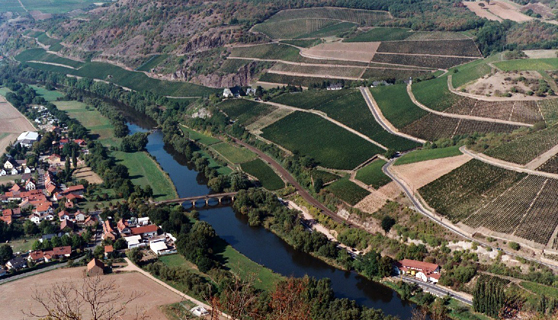

I have just finished my seventh week of winter pruning, which is work of significant duality in that it is both the most peacefully serene part of winegrowing and also the most backbreaking. Other than a day or two of dangerously cold weather in December when it got below 10 F, and the Pälzers started to worry about winter-kill of the less hearty vines (we do have Merlot and Syrah growing here for fucksake), it has been the most mild winter I have ever experienced. In the last seven weeks there has been actual snow on the ground for only three days. Hailing from Minnesota, I have always taken for granted the snow in January and February and if I felt anything for it; it was a feeling of resignation, defeat, even disgust. In this land, far from dampening my enthusiasm for the task, it brought beauty and excitement and electricity almost like when I was a kid. The landscape here is not as striking or dramatic as it is in the Mittelrhein or on the Mosel, but there is crescendo as one moves westward from the Rhein to the plains to the rolling vineyards and finally to the forests of the Haardt mountains which have even more definition and depth with snow. Then it would rain and there were even mushrooms coming up in January (some, growing where the sheep have walked and shit, insists our vineyard manager, could do the trick and fetch a good price). With temperatures often in the 50s and even 60s F -‘Good Football Weather’, it is perfect for work outdoors and for the first couple of weeks, I thought that I could perhaps be content doing nothing else every day for the rest of my life. I would often work completely alone, without anything but the ravens, hawks, and occasional delicious-looking hare to enter my field of view and break my concentration. When it rained, the gentle drumming on my raincoat, the far-away droning of a tractor or the sight of other workers in a distant vineyard only deepens the feeling of solitude and peace. I’m starting to think that outdoor work is the only work for men.
After a few weeks I was joined by a crew of Polish guest workers. I enjoy the camaraderie, but also miss that solitude. These guys are good at what they do. Not only do they bust their asses six days a week, they are extremely enthusiastic about all things Poland and happy to share everything about their culture. They seem to know every other polish worker that we encounter in the vineyards and they greet each other warmly and always take a few minutes to catch up. I joke with them that I never see other Americans in the vineyards. I need to learn Polish.
There are three phases of pruning; cutting, ripping the old wood from the trellis, and binding the 2nd year wood (canes) to the wires. It is done in three passes and requires around fifty hours per hectare to complete depending on variety and pruning method. The Guyot trellising system is used almost exclusively here in the Pfalz. Its main advantages are that the wires can be moved up to keep the canopy above the fruiting zone enabling air-flow and eliminating shading, it is easy to leaf-thin, and is suitable to both hand and machine harvesting. Within this system there are several pruning options dependent on grape variety and desired yield. The permanent cordon is gaining in popularity here for low-yield, higher quality wines, but either one-cane and renewal spur or two-cane head-trained vines represent the majority. A V-shaped system of two short stalks pruned to 5 eyes each is another option that is gaining foothold because it doesn’t need to be bound and can be easily harvested by machine. I have seen a few vertical cordon trained vines as well.
The cutting phase is done mainly with electro-shears, which are dangerously powerful and have claimed more than a couple of fingers in the region (I’ve seen one nine-fingered winemaker who now wears chainmail gloves to prevent additional losses). The hail-damaged canes of 2010 have made selection of suitable canes difficult (it needs to be healthy and pliable enough to bend in a bow without snapping.) Besides higher-quality, another upside to the permanent cordon is that it eliminates this guess-work.
The Rausziehen (Pulling-Out) is the most difficult part, but this you know. It is in any case the most physically demanding and time consuming in that it takes considerable strength to pry the wires from the cold, dead tendrils of the vines. After that, one must with hand-shears clip off the old tendrils and leaf stems while being careful not to damage the buds of the remaining stock(s). The most difficult varieties to prune are Riesling and Gewürztraminer. They have harder wood and more tendrils than most other vines. These adaptations against the colder, more blustery winters are just further proof of their suitability to northern European vineyards as if the exquisite wines they make weren’t proof enough. They take almost twice as long to prune as the easier Burgunder vines. Gewürztraminer especially holds on like an Octopus getting dragged out of a whorehouse on half-price night all the while trying to poke out your eyes and whip you in the crotch.
The upside to Rausziehen is that it is so mindlessly repetitive (on a good day you can clear-out over a thousand vines) that your brain is free to explore the deepest recesses of itself without much distraction. It has proved to be an incredibly relaxing and sedative experience for me and I have come to embrace my inner-introvert. The whole act of pruning grapevines lies somewhere between clearing the Amazonian jungles with a machete and the intricate art of Bonsai, or at least a very violent form of Bonsai. Either way, I’m sure it has its roots in meditation, though I’m not an expert on eastern philosophy in the least bit. All I really know is Miyagi and a gifted actress named Julia. I’m sure that a lesser mind would crack under such intense scrutiny, but not mine!
Binding the vines to wires is the fastest phase of work. There is no need to use twist-ties anymore; there are hand-held mechanical wire binders that are quite ingenious. It looks a little like a large pair of pliers with a spool inside. Two clicks and a pull and the cane is secured in less than a second. At this stage it is also important to make sure that the head is fastened to the bottom wire of the trellis with a very pliable rubber hose (available in all your favorite colors) that I’m sure is the envy of Danny the Junky.
After a month or so, my back was feeling pretty beat up and I was mildly complaining to myself about the fucking Dunkelfelder vines I was pruning and why the hell would anyone plant such a worthless vine anywhere in the Earth’s crust when I looked over and saw an old German woman easily in her late seventies hobble up to a row of vines across the path from me. She leaned her TWO CRUTCHES against the post and proceeded to prune the Are or so of her family vines like she probably has for seventy years (when the fuck was the last time that you saw that in California?) Suddenly my back felt just fine, thanks.
Three weeks to go.
Cheers,
Bill