
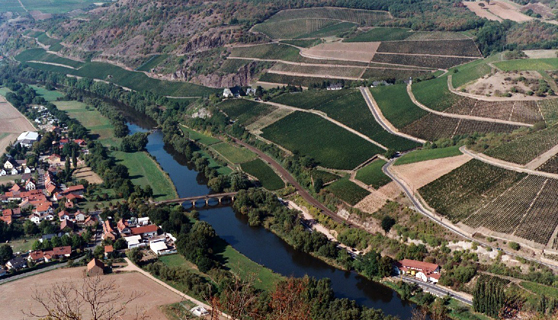

The San Francisco chapter of the German Wine Society held its eagerly awaited and well-attended holiday tasting focusing on the richer interpretations of German riesling. Alas, by the time I arrived, the 2005 Josef Rosch Leiwener Klostergarten Riesling Sekt was already gone, but I've had it before (it was delicious) and all reports on it were very positive. Meanwhile I was surprised by the NV Latitude 50 N Trocken Rosé Sekt, a blend of portugeiser, dornfelder and pinot noir from the Mosel. I wasn't expecting much, and, indeed, it was not complex, but the full tart fruit proved a very welcome palate cleanser as one moved back and forth between the stickies. Sparkling rosé is appropriate for probably every occasion, but in the midst of a sea of sweetness, it works surprisingly well. As for the sweet wines, this was a shockingly good selection and again emphasizes how vineyards so close to each other can express riesling so differently. Off the bat was probably the consensus (and my) favorite wine of the evening, the 2006 Schloss Schönborn Erbacher Marcobrunn Riesling Auslese Goldkapsel from the Rheingau. Bright and chipper on the nose, thick and honeyed taste, but integrated and finishes light and bright with hints of kiwi. Another revelation of how there are treasures to be found among the 2006 vintage. Moving 3 kilometers down and north of the Rhine, the 2004 Prinz Hallgartner Jungfer Riesling Auslese had a fresh and vibrant nose, and though felt less firm in mouthfeel, the slight aging creeping into the taste is quite delicious and the wine is textured indeed. This wine is in a really good place right now, though I probably wouldn't have guessed it as a 2004 (though I'm not so well versed in how 2004 Auslesen taste in terms of acid). Moving back up river 3 kilometers but staying above the river, the 2002 Weil Kiedrich Gräfenberg Riesling Auslese had quite a few fans across the room. Still got that vibrancy shown by the Prinz on the nose, but thick, sticky and rich in the mouth--but not heavy. Unlike the Prinz, there's very little development from age--this still tastes very primary, and, at the moment, simple. Interesting. Moving out of the Rheingau and into our lone Nahe contribution, the 2005 Dönnhoff Oberhäuser Brücke Riesling Auslese had a very structured and interesting nose. And even though the succession of Rheingaus were not as sticky or overpowering as one might fear, the Dönnhoff offered a welcome detour into the savory side of auslese. Certainly has presence and balances the intensity with tartness and, at times, earthiness. This is much more my style of auslese and I'd be very interested to see where this wine develops in 8-10 years. Staying in that famed cellar-busting vintage, but moving up to the slopes of of the middle Mosel, the 2005 Schäfer Graacher Domprobst Riesling Auslese was vibrant and melony on the nose, and tasted finely tuned with a tart crunchiness that was a bit difficult to read at the moment. Another wine for the long haul.
Just a couple of kilometers up the river, the famed Doctor makes an appearance in the 2003 Thanisch Bernkasteler Doctor Riesling Auslese. It tastes kind of like I'd expect a 2003 to taste--very rich, very honeyed, very intense. If any of that richness has faded since bottling, I can't imagine what it tasted like before. Hold. Another contender for wine of the evening was the supreme 1990 J.J. Prüm Wehlener Sonnenuhr Riesling Auslese moving back down the Mosel, just a hop and a skip from Graach. The nose here is what it's all about. Crunchy, developed, superb. Fine stuff. Heading over to the tributary of the Saar for my birthyear (yea!) 1976 Dr. Fischer Ockfener Bockstein Riesling Auslese which had some lovers and others less enthused. A bit past its peak, I'd say it still offers plenty of pleasure--a nose which has lots of nonfruit elements and perhaps a light touch of oxidation, but plenty of lively savory notes as well. A slight spritz is still there and along with alive acid, there are fading flowers and notes of grandmother attic. And, interesting to me, it was probably the highest alcohol wine on the table (at 10 percent) and even with elements fading and showing its age, it didn't show a drop of that alcohol.
The 2007 J&H Selbach Eiswein offered a soft, subdued nose and tasted bright peppery and very, very rich. Succulent and a tad richer than I prefer my eiswein to be--hence a good candidate to just let sit for awhile. I might have missed something here, as others were raving about this wine. Moving onto the Pfalz, the 2008 Darting Dürkheimer Fronhof Riesling Beerenauslese was floral on the nose with plenty of indian spices. Lots of fun. Prosciutto and melon in the mouth. Super rich interpretation, but this works. And less rich than I'd expect a young beerenauslese to be (note how poorly my expectations serve to guide me!). Finally onto a much less well-traveled region, the Mittelrhein, for the 2007 Toni Jost Bacharacher Hahn Riesling Beerenauslese which explodes aromatically with a swirl of the glass. Fruitcopia. Rich. Varied. Super fun. Explosive. A great holiday wine. And so ends another tasting and more palate education!