
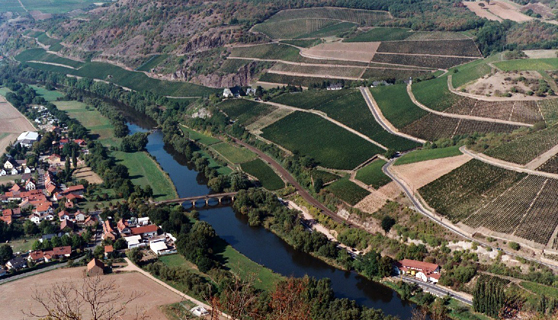

I recently had the opportunity to educate myself on the wines of Domaine Weinbach in Alsace at a tasting of more than a few of their wines from the 2008 and 2006 vintages. It was pretty incredible to experience how many distinct wines brimming with character can be raised from such a limited geographical space . . . and to think this wasn't even their full line of wines! Some research on Domaine Weinbach's excellent website (complete with maps!) and the superb producer profile on the winedoctor.com site helped me to situate the wines. Domaine Weinbach appears to have four distinct plots of vineyards all within a 2 kilometer radius of each other northeast of Kayserberg from which they make a dizzying array of wines. The Grand Cru vineyards of Schlossberg (the first vineyard in Alsace designated as Grand Cru) and Furstentum (I didn't taste any of the GC Mambourg) join the historic Clos des Capucins (originally under the control of monks before being taken away from the church during the revolution) and the lieu-dit Altenbourg. The Schlossberg is granite-based with sandy soils, is steep and thus terraced and ranges from 230 meters above sea level at the bottom to 400 meters at the top. Further to the east, Furstentum features limestone with marl and sandstone. Altenbourg lies on the lower slopes below the Grand Cru boundaries of the Furstentum with sandier soils at the 225 to 250 meter elevation. The Clos des Capucins lies at the bottom of the slope south of the Schlossberg vineyard with sand, alluvium, and granite gravel. In addition to those distinct vineyard sources, there are cuvée names (based on members of the family) that correlate with picking times and specific subplots of the vineyards. Complexity abounds! My impressions on the wines follow.
The 2008 Domaine Weinbach Riesling Réserve Personnelle (not sure where the fruit for this one comes from . . . neglected to inquire) was honeyed and aromatically welcoming, but not too giving on the palate at the moment. Also felt a bit weighty and perhaps hot, but the 13.5% didn't feel hot, just felt like the rest of the wine wasn't showing at the moment. The 2008 Domaine Weinbach Riesling Cuvée Théo (from the Clos des Capucins) had more depth on the nose, quite plush, rounded and juicy but backed by good acidity and precision. I thought it outstanding. The only wine not finished with cork at the tasting, the vinolok-finished 2008 Domaine Weinbach Riesling Cuvée Ste. Catherine was, of course, the one wine that someone thought might be corked. Consensus after opening a second bottle was that it was not. Cuvée Ste. Catherine wines are ones picked later and riper (traditionally around 25 November, the day of Saint Catherine) from the lower slopes of the Schlossberg. This one had a lighter simple nose, but tasted lots of limes at first (reminded me of a Nahe trocken at first) before moving onto tops of richer, more tropical, more gewurztraminerlike notes. Much broader, bigger style and not my style. But interesting. The 2008 Domaine Weinbach Riesling Schlossberg had a very structured, almost herbal nose, and tasted brisk, clean, watery and way less intense in a very refreshing way. Intense grip hidden underneath what appears simple at first. Now if I've got my info right, the Schlossberg Cuvée Ste. Catherine is from the mid-slope old vine portion of the Schlossberg. But, oh no, couldn't be that simple! We tasted the L'Inédit!-- a special cuvée produced only occasionally. Not sure what makes it different, but the 2008 Domaine Weinbach Riesling Schlossberg Cuvée Ste. Catherine L'Inédit! was explosively steely and limey and stony on the nose and had a touch more sugar, but, wow, textured and interesting on the palate. What a texture of flavor. Outstanding! Whatever makes it special is indeed special.
Delicious 2008 rieslings accomplished, I moved onto the pinot gris. The 2008 Domaine Weinbach Pinot Gris Cuvée Ste. Catherine (from old vines in the Clos des Capucins) had a much heavier and laden nose (we're not drinking riesling anymore!) and though not honeyed, did smell very rich. But, wow, crisper on the palate than expected, fruity, fun, simple, tang and a lightly mineral finish. This is actually a pinot gris that is fun to drink, and fun isn't the first word that comes to mind with PG. A bit of skinny grip on the finish, but I just found this one playful. Cool. The 2008 Domaine Weinbach Pinot Gris Altenbourg offered more hay and grass on the nose, and tasted thicker, plush, and much more akin to deliciously unfermented juice or half-fermented wine. Glug, glug, glug. Very interesting contrast from the previous.
Onto challenge my ability to taste and evaluate (see below) with a whole string of gewurztraminers. The 2008 Domaine Weinbach Gewurztraminer Réserve Personnelle revisited the effect I had earlier of sniffing a heavy lumbering nose and then being pleasantly surprised by a gifted lightness in the mouth. Textured, almost elegant here, light airy and flavorful, but, wow, that spicy finish is quite powerful and overtakes the experience for me. Really strong spice. Like those guys that douse themselves in cologne before a night on the town. Certainly a beautiful wine underneath that spice, but not sure I'm willing to compromise to experience it. The 2008 Domaine Weinbach Gewurztraminer Cuvée Théo (from the Clos des Capucins) had a fantastic nose—earthy, indian spices, loving it. And loving the taste too—flavorful but not overpowering, lots of unusual fleeting fruit essences, spice more playful and less domineering. Yeah this I'd probably enjoy drinking—particularly with the right meal. The 2008 Domaine Weinbach Gewurztraminer Cuvée Laurence (from marly limestone soil at the foot of Altenbourg) was pretty silent on the nose (love how I mix my metaphors of the senses) and tasted honeyed but not super rich, cleaner and crisper. Approachable certainly. The 2008 Domaine Weinbach Gewurztraminer Altenbourg offered much more of the acid I crave (which is part of the challenge for me and gewurztraminer). Bright chipper and fun, but a whole lot less gewurztraminer character—which for me is at least refreshing in this run of gewurztraminer). Just when I feel refreshed, the nose of the 2008 Domaine Weinbach Gewurztraminer Furstentum nearly knocks me off my feet. Whoooo, a bit too much there. But the taste, this is what gewurztraminer can do, and for those who feel the need to stratify the world of grapes, what makes gewurztraminer a noble variety. Layered, textured, elegant, lightly kissed of sweetness. Contemplation. In a bottle. Phenomenal. Utterly phenomenal. This is what gewurz can do. A little surpise at the end of the 2008 table was one from ten years previous, the 1998 Domaine Weinbach Gewurztraminer Altenbourg Vendages Tardive which had undergone a bit of refermentation in bottle, but really was not any worse for the wear. Honeyed but with excellent development on the nose. Clean, crisp, fun, but without any of the firm or precised edges I am used to when it comes to wine I describe as clean and crisp. This was rounded clean and fun to drink. Cool.
After a break chatting with some of my fellow attendees, I watered up and headed over to the lineup for 2006. The 2006 Domaine Weinbach Riesling Cuvée Théo (from the Clos des Capucins) had a pretty weird nose, layered, but a lot thicker in terms of aroma then I expect from riesling. Though there was some crispness at first, it turned tart, tight, hot and weird for me. Sort of flat. I didn't enjoy it. The 2006 Domaine Weinbach Muscat Réserve had an even heavier very ripe muscat nose but was beautifully light and almost watery in the mouth. Some fantastic fruit, dry and spicy on the finish. Playful and likable. The 2006 Domaine Weinbach Riesling Cuvée Ste. Catherine (picked later from the lower slopes of the Schlossberg) offered a nose with some great depth and tasted like the desert (sure we've all had dessert wines, but that doesn't mean we can neglect desert wines!). I never arrived at a conclusion for this wine—at times it seemed precise defined, racy, layered with great depth. Other times overwhelming in that dry spicy attack of flavor. Hard to pair with food. Not sure whether I liked it or not. The 2006 Domaine Weinbach Riesling Schlossberg Ste. Catherine (from the mid-slope old vine portion of the Schlossberg) was structured but struck me as just plain hot. Slight tartness here, but, yeah just doesn't come together for me. The special edition 2006 Domaine Weinbach Riesling Schlossberg Ste. Catherine L'Inédit! felt much younger, greener, more alive and refreshing on the nose and tasted plusher with better development, crisp fruit, structure and balance. But still not feeling integrated, or at least entirely so, so I'm not sold. 2006 rieslings here appeared a challenge.
Moving on, the 2006 Domaine Weinbach Pinot Gris Cuvée Ste. Catherine (from old vines in the Clos des Capucins) smelled and tasted first plush, then flat. The hot, dry desert returns. I am not feeling these wines. The 2005 Domaine Weinbach Gewurztraminer Cuvée Théo (from the Clos des Capucins) (thank goodness for a break from 2006!) had a super nice rich and spicy nose and tasted crisp upfront, clean precise, maybe slightly hot, but still very enjoyable. The 2006 Domaine Weinbach Gewurztraminer Cuvée Laurence (from marly limestone soil at the foot of Altenbourg) on the other hand, had a pretty boring nose, and though a tad light on the palate at first (very nice) turned rather rich and intense with tons of spice. Very pretty wine. Finally, the 2006 Domaine Weinbach Gewurztraminer Altenbourg had a lovely honeyed aromatic nose and tasted absolutely superb—though thick and sweet I still found it elegant, focused, and the slight intensity was completely supported by the overall experience of the wine. Phenomenal gewurztraminer is a great way to end a tasting.
I have a few other thoughts on the experience that I may type up and add later as postscripts to this post. But a very educational experience for me. Wonderful producer.