
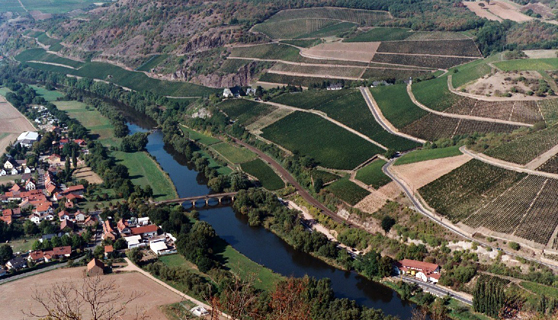

Germany 2010
So I picked a hell of a year to move to Germany to persue a career in winemaking…
You might have already heard that the 2010 vintage in Germany is the smallest in a quarter century -here are some details. It was a late spring this year and a very cool, cloudy June by modern standards. This first hit home for me by way of poor spargel and strawberry seasons to kick-off our arrival in Germany. The weather led to fruit-set problems throughout all of the German wine regions. To make matters worse, the Pfalz (the Südliche Weinstraße in particular) suffered another devastating setback when on the 9th of June, the region was rocked by a major hailstorm. Much of the vineyard area south of Neustadt was affected (and I have heard mixed reports from Estates in the Mittelhaardt as well.)
A change of fortune brought an incredibly hot July (high 30s and even low 40s in some regions for much of the month) and everything seemed to be kinda back on track (I visited Bürklin-Wolf on one of the few rainy days in July and they were thrilled with it.)
And then came August. August was the rainiest month in like... (or so I’ve heard) recorded history in Germany. It rained damn near every day (and when it wasn’t raining, it was very hot.) The best news is that I collected a bumper-crop of Chanterelles (Pfifferlinge) as I lived a life of leisure taking the summer off in the beautiful woods of Hessen.
In September we moved again. This time to the Pfalz and here I started an apprenticeship in winemaking with a Weingut that you’ve never heard of if you live outside Germany. I quickly learned what effect the rain had on different vine-varieties planted in different terroir (and what effect the rain had on already weakened-by-hail vines). As was the case all over Germany, the only way to make the most of the situation in the Pfalz was to employ extremely rigorous selection practices in the vineyard. Vineyards which would normally be machine-harvested were now being harvested by hand (by me and the crew) at a much greater cost than usual. Yields for some vineyards are lower than 8 hl/ha (0.59 tons/acre) which begs the question: at what point does it become uneconomical to even pick?
I have really come to respect clay as a soil-type this year (and Pinot Gris and Gewürztraminer as vines.) Though in most years it serves to slow-down the ripening process, it really proved its worth in a year like 2010 by keeping the botrytis at bay by way of its impenetrable density. If you could have seen the beautiful Pinot Gris (Grauburgunder) that we picked this year, when across the road on more porous ground there was nothing but rot, you’d be amazed (and I’m really proud of that PG!)
In general, the Pinot Varieties (Noir, Gris, Blanc, Auxerrois) did well. Pinot Blanc is extremely important throughout Germany (which is shocking considering how difficult a sell it is in the US) and both the Kabinett and Spätlese are delicious (and both finished fermenting a couple of days ago), though a lot of fruit had to be dropped to ensure a clean crop.
There is significantly less Spätburgunder, though what came in is very good. It was a ‘Story of the Clones’ this year with loose-clustered clones (such as Mariafelder) giving the best result. Tight Pommard clones were disaster as rot took most of everything.
The little Auxerrois that we have is exceptional. One of my favorite times of the day is taking an Oechsle measurement and taste. Beautifully concentrated and luscious even from tank.
The Estate Sankt Laurent was completely fucked. It is a notorious uneven-ripener as is and in 2010, the individual bunches looked like a green to black rainbow on everysingle bunch. We ended up harvesting a vineyard a little to the north of surprisingly exceptional quality and the results are one of my favorite red wines of the vintage.
The Silvaner (another personal favorite) is healthy and extremely concentrated maybe due to the high pectin-content of its skins (which also called for a much longer, slower pressing.) It has been the slowest fermenting tank this year, decreasing by an average of about two Oechsle per day.
The GG vineyard Riesling was harvested in 3 passes by hand, Spätlese being the highest prädikat. Auslese and beyond was certainly achievable, though only in the sense of must-weights (as there was plenty of full-bore wet-botrytis) but good, clean, phenolically golden-skinned Riesling was at a premium (think 2006.) After a vorlese (dropping rotten and unripe fruit), and a kabinett harvest, we were able to let the Oechsle climb to over 95 before harvesting. The wine finished at -1 degrees Oechsle today (about 8 g/l rs) and is excellent.
My Eiswein ambitions will have to wait until next year because there just wasn’t enough fruit to risk.
Strange as it is, the cool June was a blessing in disguise as the ‘normal’ amount of pollinated fruit would have had no chance to achieve verasion in August given the rainfall. Though there is hardly any wine (25-30% less than last year overall), it is one of those years where if you produced good wine, you produced very good wine (through back-breaking selection.)
Stick to the names you trust and expect a lot less wine. I’d be very weary large production, co-op, frosted-bottle German Riesling from 2010.
Harvest is done, most of the wines have finished fermenting, I disgorged last years Sekt this morning, and last years reds and 2008 Barriques are bottled next week. I don’t sleep much and every day is like a 12 hour gym workout, but I’ve never been happier (and I get to drive a tractor.)
Cheers!
Bill