
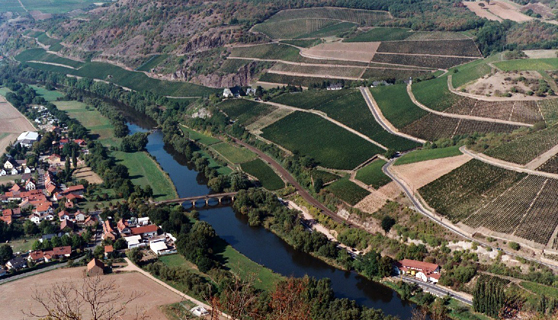

If you are seeking to understand the concept of terroir, that can be done through a tasting of the Single Vineyard Pinot Noirs of St. Innocent.
I had the occasion to do just that recently, through two tastings in very close proximity, and it was one of the more intriguing and intellectually edifying wine learning experiences I've ever engaged in.
The first tasting was at dinner. My wife and I had decided to go to the Pearl District in Portland, where there is an abundance of fine restaurants. I realized then that she had never been to 1001 Restaurant, one of the better ones, and it was time to remedy that lapse. We were seated in the somewhat quieter upstairs section with its charming views of the district, hurried streets below and still vistas of old buildings mingled with new, and the bridges of Portland at a further distance.
The decor is spare and elegant in 1001, and the staff has that unique combination you can see nowhere else, a blend of consummate training and attentiveness with the casual ease and genuine warmth of Portland.
We had a wonderful dinner, but the point of this story is St. Innocent, so we'll focus on that. By the time our main courses arrived, with the usual division of a delicate fish dish for her and a heartier meat dish for me, we had to make a decision about wine. 1001 has an excellent wine list, so the choice was not easy, but once I spotted a half bottle of the St. Innocent Shea Vineyard Pinot Noir 2008 at a very reasonable price, and was reassured by the sommelier it was not infanticide to consume it, I decided that would be the wine.
The Shea was brilliant! A perfect example of the best style of Willamette Valley Pinot Noir from a good location in the hands of a perceptive and light-handed winemaker, it was not only exuberant with dense, dark cherry, it had a solid earthy middle-palate and a wisp of lingering spice at the finish. And what's more, it immediately conformed itself to the food in the most delightful way, light and fruity enough with the halibut to show the highlights of the dish, and rich and meaty enough with the pork to support and compliment it perfectly. Few red wines can do that easily and well; for good Pinot Noir, it's easy.
This was a case where the wine--specifically the wine---made the meal.
Fast forward a week and serendipity takes a hand. I received word that the Oregon distributor, Lemma Wine Company, was holding a double tasting of new Austrian wines and the new releases of St. Innocent Pinot Noirs. I decided I had to be there.
Came the day and, suitably lubricated with the new additions to the Austrian lineup from Winebow (which were pretty impressive in themselves), I stepped over to taste the St. Innocent with the winemaker/president, Mark Vlossak.
Mark had on display the 2008 releases of St. Innocent Pinot Noir Villages Cuvee Willamette Valley; Temperance Hill Vineyard, Eola-Amity; Momtazi Vineyard, McMinnville; and Freedom Hill Vineyard, Willamette Valley.
Pinot Noir Villages Cuvee is very much in a 'Burgundian villages' style, and also very much a specific intent to combine younger vines with some older, more established vines to achieve maximum effect. The source of the Villages Cuvee is the Vitae Springs Vineyard in the south Salem hills, but it is a combination, a melding of older, more mature vines and other younger vines from other vineyards where plantings were done to replace phylloxerated vines.
This is smart husbandry of both the vines and the St. Innocent 'brand', for it allows use of the younger vines in a stable cuvee release, while keeping the inherent terroir of the single vineyards intact.
The grapes were fermented in stainless steel barrels after two days of cold maceration; the wine was aged for 12 months in in French oak barrels (only 20% new), and bottled without fining or filtration in November 2009. The wine is sturdy, and pleasant, and in the style of the Willamette Valley, with the hallmarks of red fruits, pie spices and mushroomy, earthy undertones. A case or two would not be remiss in the cellar of a collector, to serve as a reliable Oregonian standard.
But the Villages Cuvee is more about the regional terroir, more about being a general statement of what the entire Willamette Valley Pinot Noir is, for it is a conscious blend of old and young vines, more than an expression of a specific place. For that, you have to go to the Single Estates that Vlossak produces.
The Single Estate Pinot Noirs
Temperance Hill Vineyard is located in the Eola-Amity AVA in a volcanic uplift, with well-aged vines firmly rooted in weathered basaltic soils. Those soils translate through the Pinot clones used as both bright, fresh red fruit and a perceptive minerality. It's red cherry versus black here, with a tart/sweet strawberry, bright and lively and firm with acidity, and impressive purity---and intensity--- of flavor. But there's an intriguing smokiness too; so evident that Vlossak cites it as his favorite wine with grilled meats.
Momtazi Vineyard is located west of McMinnville on a steep hillside, with younger vines than Temperance Hill. It is also warmer, with more wind effect, and has a 'roasted slope' effect on the Pinot Noir struggling in the thin volcanic soils.
The Momtazi, it is immediately and dramatically apparent, is as different from Temperance Hill as any two wines could be. Same harvest; same winemaker; similar yields; and similar treatment post harvest by Vlossak. But these are inescapably two different Pinot Noirs.
Where the Temperance Hill was outgoing and exuberant in its youthfulness, the Momtazi is almost sullen and shy and unrevealing. There is indeed an almost Cote Rotie-like element to the wine, a stubborn, dark-fruited, roasted blackberry/marionberry and totally unexpected cassis. Where the Temperance Hill was sweet pie spices, the Momtazi is---again, roasted---Indian and Asian spices, mysterious and tantalizing. Where the Temperance Hill was free and easy with its fruit, the Momtazi is tight and unyielding (not to belabor the point, but very much like a young northern Rhone syrah would be.) The Momtazi demands patience, and its dense, compacted, slow-yielding nature would reveal itself only with years of quiet cellaring, I think. And in its maturity, it will be magnificent.
But we aren't finished yet.
The final wine, the Freedom Hill Vineyard, is from vines planted in 2004, to replace the original lot which succumbed to phylloxera that same year. Thus, this "new" Freedom Hill is from younger vines than previous vintage releases, but is more closely designed to suit the cold, westerly and windblown location through careful clonal and rootstock selection.
And again, the Freedom Hill is as different from the Momtazi as you could imagine. It is somewhat more akin to the Temperance Hill---but not really, for while the two share an exuberance of friendly, warm fruit at an early age, there is also that brooding character of the Momtazi that is not apparent in the Temperance Hill.
The singular characteristic that distinguishes the Freedom Hill Pinot Noir is its amazing intensity. Everything is more intense in this wine: the fruit is black, black cherry, almost a brandy-marinated black cherry. But the lean, intense line of mineralic acidity and the surprising strong tannins are in keeping with the massive fruitiness, and keep it from seeming unbalanced.
Simply put, everything is large in this wine, but it's all large in the right harmony and proportion. It is eminently drinkable, and thoroughly enjoyable now---but it would be a serious mistake to yield to temptation and guzzle it down now, for this wine will age into a truly heroic Pinot Noir. It will, I believe, go beyond, the Momtazi even; and the tannins, already softening now, will become supple and velvety soft, with that intense, rich black cherry fruit still startling in its flavor, but with an earthiness, a mushroomy, wet leaves, river bottom black soil quality that merely hints now but will emerge with time to complete the balance of the wine and bring it to its full force.
So here, counting the Shea tasted at 1001, but eliminating the Villages Cuvee as a winemaker's blend (but otherwise keeping it intact and in memory as a lovely Pinot Noir; simply not a single vineyard focus), we have four Single Vineyard expressions of Pinot Noir, all at the hands of the same winemaker---and that winemaker intent on allowing each site to express itself as much as possible. And the result is four entirely distinct and different wines, each a particular expression of Pinot Noir, but each unique and individual with its own very obvious identity.
If the three pillars of a great wine are the grape, the place, and the winemaker---and I firmly believe they are---we have one winemaker, one grape variety, and four singular sites within one climatic region. Yet we clearly have four different wines.
I'm content to let others argue micrometrically and infinitely about what terroir is and how it manifests itself, since that is apparently what makes them happy. I've tasted the St. Innocents, and my case is rested.

