

Last night, 25th July 2010, was dinner at my dad's and the main course was to be Rosemary Roasted Cornish Game Hens with Roasted Potatoes (the former are really just small, stocky, fattened young chickens slaughtered at 5 weeks of age - not really game nor hens nor from Cornwall). My youngest sis and dad's cook prepared all the dishes (the others being Vegetable Spaghetti and Gorgonzola-Walnut Mesclun Salad) except for dessert. With our meal, I chose from dad's wine cav something I've not had before:
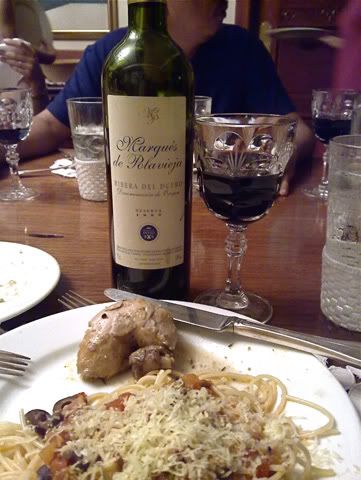
1999 Marqués de Polavieja* Reserva (Ribera del Duero) - A brand by the 133 year-old sherry producer Bodegas Williams & Humbert, this is, as I understand, made up of tempranillo with a smaller percentage of garnacha, aged for 12-18 months in French and American oak and 12 months in bottle.
Moderately full-bodied, ripely and darkly fruited (cherry, raspberry, underlying blackcurrant) with added notes of slight red spice, underlying leather, violets, licorice, bit of cedar, vanilla. Acidity is low, the fruit is soft and quite smooth; the wine has moderate-to-good push/drive. Straightforward, not really complex at all; well-concentrated and notably extracted (comes off as quite contrived, actually). That all said, if one could find it at around US$25-US$35, I'd say it would be a buy for a casual/house Ribera del Duero. I don't know how much it cost and my dad doesn't even remember where he bought it.
*nb: Unrelated bit of trivia - there was a Governor-General of the Philippines in the late 19th century (when the Philippines was still ruled by Spain) named Camilo Garcia de Polavieja under whose watch Jose Rizal, the Philippine national hero, was executed.
The chicken I found nice enough but not interesting, but the pasta was nice and fresh - perking me up after a long day on the course.
Thereafter, we had a blind comparison of 2 commercial leche flans (our local version of crème caramel) - this arose out of a friendly bet between my dad and youngest sister who put their respective favorite commercially sold leche flans to the test.
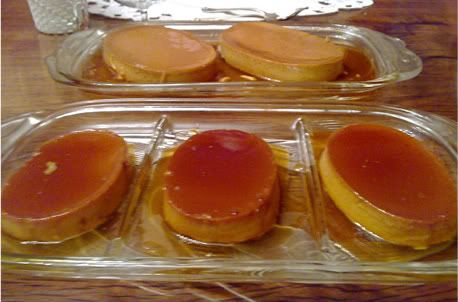
The lighter-colored ones at the top of the photo are leche flans "A", while the ones at the bottom are leche flans "B".
Leche Flan "A" - Lightly caramelized, markedly less sweet, not very creamy in texture (they used a lot of gelatin in this I think), a bit of an "eggy" aftertaste. Light on the palate.
Leche Flan "B" - Darkly caramelized (just short of bitterness), very creamy (a lot more milk and egg yolks for sure), sweeter. Heavy on palate. Immediately more enjoyable, but I can't eat too much of this as palate fatigue would quickly set in.
Leche Flan "B" won with 6 votes to 3; Hisako, Catha and Dad voted for Leche Flan "A" while the rest of us went for "B". It turned out Leche Flan "A" was my dad's favorite and Leche Flan "B" was my youngest sister's.
Fresh fruits, coffees and snifters of cognac rounded off the meal.