
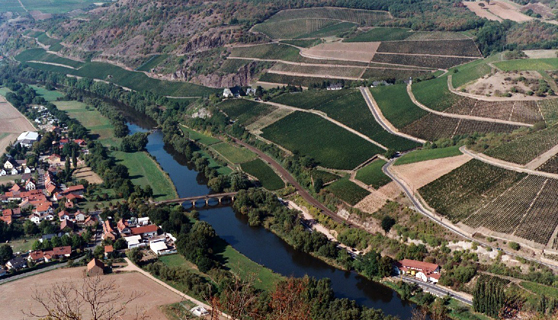

Fun weekend at Nick and Daniela’s place, thanks so much! Lots of guests, kids, food, wine (most of which Nick’s)...
Missed (re-)tasting Vollenweider’s 2008 Kabinett as I was half an hour or so late, thus started with:
Carl Schmitt-Wagner Riesling Spätlese #10 Longuicher Maximiner Herrenberg 1989
A wine of no more than medium concentration, but that has aged very harmoniously. Full bright yellow-gold. Nicely petrolly-minerally, lovely ripeness to mature yellow fruit. Medium length. Ultimately lacks density, but nice, and nowhere near over the hill. Rating: 87-
Egon Müller Scharzhof Riesling Kabinett VdP-Auction #6 Scharzhofberg 2001
A wine I had not had since the VdP-Auction tasting. Great subtlety and finesse to the nobly minerally sweet and dry style here, finesseful herbs and fruit. Subtle but very complex tobacco. Very long on the finish. Lovely dryness and acidity. To me, if in great part for stylistic reasons, one of the wines of the night. Rating consistent with last time’s. Rating: 89+/~90
Joh. Jos. Prüm Riesling Kabinett #12 Wehlener Sonnenuhr 2001
Superficially sweet(er) yet lighter in concentration, softer, lower acidity – an interesting discussion ensued as to whether that makes a wine easier to enjoy or more saturating. Lightly flintier minerality. May buttery spring flowers. Fairly noble, too, a style we all love. Medium plus length. Pretty wine that Olaf feels would be difficult to make nowadays (due to the climate change). Rating: 88
Daniel Vollenweider Riesling Kabinett #02 Wolfer Goldgrube 2001
Daniel’s exceptional 2001 Kabinett of which only 300 liters made. What a wine – no one would have marketed a wine like this as Kabinett when I first got into German Riesling (seriously, this might have been a VdP-Auction Spätlese back then). Medium yellow colour. Faintly reductive (probably the reason Nick found a recent bottle slightly funky). Darker minerality. Sweet, thick and highly concentrated. Intense. Oily-viscous. Chewy almost, a Kabinett of rare density. Lovely little lemon rind bitter note. Very long on the intensely minerally finish. Olaf finds this utterly delightful. Rating: 90+/91?
Weingut O. Riesling Kabinett feinherb Kräuterhaus 2009
18 g/l residual sugar at 11% alcohol, but did not suffer from being served after the sweeter Kabinetts. Beautiful blossom and blackcurrant to some grapefruit. Tiny lime bitter note. Soft stone dust. Pretty Feinherb (= “off-dry”, not sweet). Just faintly tannic. Rating: 89
Joh. Jos. Prüm Riesling Kabinett #4 Wehlener Sonnenuhr 1998
Medium-pale gold. Note quite as clean and pure as some, fractionally dusty-medicinal, faintly volatile. Medium concentration and sweetness. Soft mushrooms. Not too lively herbs and spring flowers. Some acidity. Not too interesting little bitter note. Relatively mild and medium-short on the finish. Prefer the #6 from the same vintage. Rating: 86(-?)
Château Troplong Mondot St. Emilion 1994
Contribution of mine. Not the greatest bottle of this wine ever, but a 1994 that keeps aging harmoniously, and is really one of my favourite Troplong Mondots (not one of my favourite Châteaux) for exactly that reason. Lightly plummy ruby, soft black hue. Nice cherry, some oak, soft truffle and tobacco leaf. No more than medium intensity (anymore). Fairly long. Some noticed that faintly metallic streak underneath that I last noted at release – probably best to drink this up. Rating: 89-/88(-?)
Château Ducru-Beaucaillou St. Julien 1995
My wine of the night, one of the most Lafite-like vintages of Ducru-Beaucaillou. Fresh ruby-black. Youthfully tannic, some oak. Attractive lead pencil and green tobacco leaf. Firm yet subtle (and potentially finesseful) fruit. Lovely minerality. Showing that green banana/tobacco leaf touch to the tannin that Olaf and I agree is what used to keep (still) more classically styled Bordeaux like this from oxidizing (or becoming lame, or collapsing, to paraphrase Olaf) with airing. Rating consistent with last time’s. Rating: 93+/94(+?)
Château Rauzan-Gassies Margaux 1986
Wood preservative on the nose, not as off-putting as in some bottles of 1986 Bordeaux, even so, Andreas immediately asked if he was “obliged” to drink his glass. Olaf and I soon felt we should not have drunk ours either. Medium ruby-black, watery at the rim. Some medium-soft mature fruit, black truffle and other mushrooms. A touch of caramel. Medium-short on the finish. Rating: 84-
Château de Marbuzet St. Estèphe 1986
Nice ruby-black. Nice liqueur-like cherry top note on entry, but light on fruit on the mid-palate and beyond. Very tannic, in fact too tough and tannic on balance. Increasingly (with airing) nice tobacco. Medium-short on the slightly tough finish. Rating: 86(-?)
Jean-Louis Chave Hermitage 1981
Medium-light ruby-black, some watery-orange at the rim. Dry, lean and tough compared to e.g. the 1982 and 1983. Noticeably bretty, but not too barnyard or horse-sweaty at all, let alone off-putting. Aged roasted herbs, a little iron, spice and dried herbs such as sage and verbena. Flimsy, fading fruit. Dried forest floor. A bit smoky. A touch high-acid, slightly tough, even more so with airing. Rating: 86-/85(-?)
Poulet Père et fils Beaune 1er Cru Domaine des Saux 1959
Quite well-preserved. Ruby-orange. A bit truffley-tough and quite tannic. Not especially fruity anymore for a 1959 (had some terrific négociant village Burgundies from the vintage over the years). Still fair enough concentration, body and intensity. Medium length at best. Rating: 83-
Fritz Haag Riesling Auslese #12 Brauneberger Juffer Sonnenuhr 1995
Pale green. A bit lean for a 1995, and most definitely lighter concentration than the Fritz wines of the past. Could be riper and sweeter, too. Some pretty herbs, apple, slate. Fairly high acidity. Rating: 86(-?)
Markus Molitor Riesling Auslese* #37 Zeltinger Sonnenuhr 1994
Pale yellow-green. Good ripeness, concentration and richness, minerality and length. Pretty and nicely tight apple and stone fruit. Quite expressive albeit youthful. An Auslese of density, but quite dry – my guess is, it will become yet drier with bottle age (but of course, continue to age well). Lovely complexity and depth. Quite long. Olaf was full of praise for this (and Molitor’s wine in general). Rating: 89+/90(+?)
Weingut O. Riesling Spätlese Ungsberg 2009
Palest green. White cherry blossom, lime blossom, apple, but also a bit yellow-fruity. Quite intense. Lightly tannic on the mid-palate. Subtle herbs. Faint blackcurrant top note (hinting at perfect Riesling ripeness bordering surmaturité). Nicely clean and pure. “Lasting and long acidity”, which Olaf thinks is an Ungsberg trademark. Nicely “prickly”, too. Rating: 89+/~90?
Weingut O. Riesling Auslese #006 Ungsberg 2008
Pale green. Unique fruit. Quite ripe. Heavier herbs and blossoms. Round but less fresh and lively. The 80% botrytis is noticeable. Soft vanilla, not the high-toned type one gets in top vintages. Lightly creamy. Just barely tannic streak here at all. Medium length. Faintly rubbery-superripe with airing. Rating: 88+/89(+?)
Of course, after all this, late at night, we became hungry again, and in turn, thirsty:
Château Léoville Las Cases St. Julien 1978
Says “Réserve Particulière Mr. M. A. Bunford” on a stick-on label – anyone know who he is? Medium-deep garnet-ruby, soft orange at the rim. Noble smoky tobacco, faint ashtray and lead pencil top notes. Reasonably good fruit for a 1978, maybe a little sweet, dry and dried cherry, blackcurrant and blackberry. Leaner than ideal, but not tough. Nutty-oaky in a way Olaf refers to as chipboard-scented. Medium-short. Drink up! Rating: 87-/86(-?)
Château Clerc Milon Pauillac 1990
Bright ruby-black. Tree bark scented oak, a bit nutty. Lightly roasted fruit. Intense, fairly complex. Concentrated and dense Clerc Milon. Good body. Quite oaky. Soft acidity. Firm but rather oak-induced tannin. Still youthful, even for the vintage. An impressive if oaky wine that a number of people around the table absolutely raved about. Rating: 90+/91?
Château Léoville Barton St. Julien 2003
Lightly plummy-purple ruby-black. Exotic top note, but nicely ripe and nowhere near overripe fruit. Touch of nutty oak, faint marzipan. Firm for a 2003, just fractionally loose in comparison to my favourite Léoville Barton vintages. But quite tannic. Good body, slightly hot if not spiky alcohol. A bit oaky on finish. Opened up with airing. Unusual insofar as it is a Léoville Barton that gives pleasure early, but certainly among the more ageworthy 2003s. Rating: 91+/92?
Bruno Giacosa Barbaresco Gallina di Neive 1998
A “Casa Vinicola” wine, i.e. made from bought grapes same as the Santo Stefano, not farmed by the “Azienda Agricola” itself. Medium raspberry-red, soft orange, stronger black hue. Nicely tight and firm yet quite subtle fruit, good complexity, tea-like tannin and finish, quite palate-staining yet finesseful, fairly long. Better than the Asili from the same vintage, but not on the level of the Santo Stefano di Neive and the Rabajà. Needs and deserves more time in bottle. Rating: ~91(+/-?)
And a wine Oliver brought along to taste, which we did the following morning (= read: around lunchtime):
Carl Loewen Riesling Trocken Alte Reben “1896” Maximin Herrenberg 2009
A very modern interpretation of an old-vine bottling. Yellow-gold. Fairly deep, quite unique and firm minerality. Relatively complex straw-tinged “fruit”. Creamy-buttery-soft toffee. But lacks depth. Smells enzymed. And it tasted as if it had gone through malolactic fermentation for a while. Relatively thick, a bit viscous, broad on the mid-palate. A bit low-acid for 2009. No astringency. Faint CO2. Pretty if tiny lemon rind bitter note. Seemed fairly long on the finish for a moment after the cork was pulled, then rather short, then with airing in the acceptable midfield. Saturating. Rating: 88(+/-?)
Greetings from Switzerland, David.
_________________
„J'ai gâché vingt ans de mes plus belles années au billard. Si c'était à refaire, je recommencerais.“ – Roger Conti